When Does the John Jay Homestead Farmers Market Start Up Again
Know Before Yous Go...
More Info
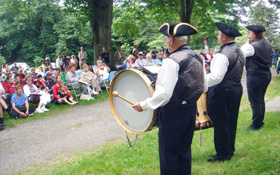
Come explore John Jay Homestead Land Historic Site, an original American Experience.
Experience American History at the dwelling house of Founding Father John Jay and 5 successive generations of the Jay family. Do you desire to learn, from a showtime-mitt source, near the nativity of our nation? Founding Father, John Jay, can enlighten you. Do the origins and changes of the antislavery motion pique your interest? You will gain perspective from John Jay's son and grandson who were at the forefront of the movement. Discover the stories of the slaves who lived at John Jay Homestead before the family championed the abolitionism cause. Do yous wonder what life was like for early 19th century women? John Jay's daughters have a story to tell.
Experience important furniture and decorative arts
Adore the chairs used by the beginning United States Senate; meet a John Vocalizer Sergent portrait hanging in the Ballroom, a Houdon bust of John Paul Jones, and the Biennais mirror owned by Marie Louise, the second wife of Napoleon Bonaparte. These original objects and many more than can be found in John Jay Homestead's drove. Return ofttimes to run across a current, beautifully curated special exhibit.
Feel John Jay'south Bedford Farm
Enter the Carriage Barn Education & Visitor Center where you volition begin to larn about John Jay Homestead through videos and interactive educational displays. Many of the original subcontract buildings exist today. Did you know that draft horses were the tractors of the 19th century farm? At the Restored Draft Horse Befouled imagine life on the farm, plowing the fields. What was information technology like to be a kid in the 19th century? Walk upwards to the one room Schoolhouse and imagine yourself with chalk and lath in hand.
Feel the great outdoors
We take 62 acres -walk to the ice pond stocked with fish and downwardly the beech allée. Stroll through the beautiful Sun Punch Garden, Herb Garden, and Terrace Garden. In the wintertime, come and cantankerous-land ski or snow shoe. During the spring and summer, bring a picnic and spend the twenty-four hour period. On Saturdays, May through October, shop our regionally acclaimed Farm Market.
Experience the agronomical past
Peer into the craven coop; meet the heritage breed chickens. Come run into the community garden and bee hives and feel the connection with the Homestead'south agricultural past. Visit the Crimson Barn Discovery Center to milk our "cow," Buttercup.
Experience nifty programming and events
The annual Scholars Lecture Serial brings world renowned authors and historians to the site. Our signature Befouled Trip the light fantastic toe offers families an energetic start to fall. Attend tours, special exhibits, and lunches highlighting the Homestead's collection. The outstanding education department offers standards-based school programs and produces children's and family events throughout the year.
Experience an original American Feel.
Don't miss these popular destinations and attractions inside or near the historic site:
- Carriage Befouled Education & Company's Center
- The Farm Lane-the just original entrance to the historic farm in one case endemic by John Jay
- The Formal Gardens-located through the white gate, a fountain and sundial course the centers, beautifully maintained past the Bedford Garden Club and Friends of John Jay Homestead
- The "Ha-has"-a unique mural feature consisting of rock walls congenital to proceed grazing livestock from getting near the house, but remain invisible when looking downward the backyard
- The Herb Garden-created in 1991 on the site of an historic cutting garden and greenhouse. Maintained by the New York Unit of the Herb Lodge of America.
- Water ice Pond-created for producing ice in the winter to use twelvemonth-round, now a picturesque spot. The route downwards to the pond is part of the Tree Walk, lined with Red Maples
- North Courtroom Garden-on the north side of the main house, between the wings. It beautifies the attainable archway as well as displays a sampling of plants effectually the site. Maintained by the Hopp Ground Garden Club
- Picnic expanse-picnic benches are scattered throughout the picturesque site
- Tree Walk-feel the leafy landscape created by John Jay. Highlights include: Linden (Tilia americana), Red Maples (Acer rubrum) and European Beech (Faga sylvatica) trees, all celebrated and gorgeous.
Mailing Address
PO Box 832 Katonah, NY 10536
Hours of Operation
-
May through October:
Carriage Barn Education & Visitor Eye
Open Midweek through Saturday from 10:00am-4:00pm
Gratuitous admissionRed Barn Discovery Center
Open Wednesday through Friday by reservation only
Costless admissionGrounds
Open from sunrise to sunset
Free access -
November through April:
Wagon Barn Education & Company Middle
Closed for the flavorDiscovery Centers
Closed for the flavorGrounds
Open up from sunrise to sunset
Free admission -
Day Apply Activities: Seasonal.
Hiking, birding, mural painting, photography, equestrian trials and Xc skiing. Picnicking: Available twelvemonth-round.
Fees & Rates
Most New York Country Parks charge a vehicle use fee to enter the facility. Fees vary by location and season. A list of entry fees and other park use fees is available below. For fees not listed or to verify information, please contact the park directly.
The easy-to-use Empire Pass card is $lxxx- and your primal to all-season enjoyment with unlimited day-utilize entry at well-nigh facilities operated past Land Parks and the Country Dept. of Environmental Conservation including forests, beaches, trails and more. Purchase online or contact your favorite park for more information. Learn more virtually our Admission Programs including the Empire Pass.
ALL OUR FIELD TRIPS ARE AVAILABLE VIRTUALLY AT NO Toll!
John Jay Homestead Country Celebrated Site invites you lot and your class to acquire virtually the life of John Jay and to explore the exciting times in which he lived.
The Homestead offers a variety of program options that run into electric current curriculum standards. Each plan provides students with a showtime-hand look at the changing nature of everyday life by comparing today's lifestyles and concerns with those of Jay'south era. The programs encourage students to use the disquisitional thinking skills of a historian or social scientist, request them to read, clarify, apply, synthesize, and evaluate historical information. All our programs run across mutual core standards in English, Language Arts and Literacy and in Reading History/Social Studies. Learning objectives are achieved over the form of three lessons designed for Remote, Hybrid, or In-Person learning models.
All program materials including lesson plans, readings, worksheets, and virtual tour videos are delivered to you via USPS on a flash drive. At that place is no charge for these programs – nosotros only enquire that you report to usa the number of students attending this virtual field trip. Click Hither to request a program.
Program Options
So and Now
What was life like 200 years agone? Students will compare and dissimilarity their everyday lives with the fashion the Jay family lived in the early 1800s. A virtual tour of the historic firm will focus on the lack of modern conveniences and its impact on everyday life. In addition, students volition discuss the differences between urban, suburban and rural locations.
Grade level: K–2
Standards: Social Studies 1, five; English Language Arts one, 3; Arts 3
John Jay, Revolutionary Spymaster
Though widely historic for his political and diplomatic achievements, John Jay played an important role in creating a spy network to help defend the colonies during the Revolutionary War. Students will read stories about the defenses protecting New York, the split loyalties of its inhabitants, dissimilar spying techniques, and historical anecdotes near of import political figures. Ciphering activities and a virtual bout of the celebrated firm museum are as well included in this program.
Grade level: 4–6
Standards: Social Studies 1, 2, 5; English Language Arts i, 3, 4
Slaves, Slavery, and the Jay Family
How is a servant different from a slave? What's the deviation betwixt manumission and abolition? Why did many of the Founding Fathers continue to ain slaves as they established a nation where "all men are created equal?" We provide an experience that will help your students answer these and other probing questions. While they near tour the historic business firm museum and written report primary sources, your students will come up to understand John Jay's alien attitudes every bit slave owner and manumission advocate and acquire about his son William's role in the abolition movement. They will also acquire about the lives of some of the slaves who lived at the Homestead. Please notation that this program is intended for students who already have some working knowledge of the institution of American slavery – information technology is not designed as an introduction to the subject.
Grade level: 6–12
Standards: Social Studies one, ii, 5; English language Linguistic communication Arts 1, 3, 4 </P>
During twenty-seven years of service to his state and nation, John Jay looked forrad to the day when he would retire with his wife and family to "the house on my subcontract in Westchester County...."
In 1785, Jay had inherited a 287-acre package, originally purchased by his maternal grandpa, Jacobus Van Cortlandt. Two years later, he inherited an adjoining 316 acres from an aunt. He before long began developing the land as a farm, purely for business organization purposes. In the late 1790s, he decided to make the Bedford subcontract his abode in retirement. He enlarged his subcontract manager'southward house to go his own domicile, increased the number of outbuildings on the farm, and moved here in the summertime of 1801. His married woman, Sarah Jay, joined him later in the fall, and the couple lived hither with the three youngest of their five children.
Merely months later, in May 1802, Sarah died. Jay never got over the loss of his beloved wife, only continued to reside on the farm for another twenty-seven years with some of his children and grandchildren. Jay's daughter Ann, known familiarly every bit Nancy, took her mother'south place every bit female caput of the household. Jay's younger son William spent much of the first decade of the nineteenth century away from home, starting time as a student at Yale, and so as an apprentice lawyer in Albany. Sarah Louisa, the youngest child, also spent much time abroad as she grew older, first as a educatee at a girls' schoolhouse in Albany, and then later wintering with her older siblings, Peter Augustus in New York or Maria in Albany. Sarah Louisa died in 1818 at the age of twenty-vi later a brief illness.
John Jay was finally able to enjoy a considerable amount of family companionship after his son William married Augusta McVickar in 1812. William and Augusta moved into the house, and had five children by the time of John'southward death in 1829. In his last years, Nancy was also all the same at home, and there were frequent visits from Maria and Peter Augustus.
As for the farm, its produce changed over time. When Jay was live, Bedford was part of the breadbasket of New York City, and the subcontract'due south principal products were wheat, butter, apples, and pears. This remained much the same during the time the holding was in William Jay'south ownership, post-obit John's death. Information technology began to modify in the next generation, that of William's son, John Jay Two. Given the condition of the roads and bachelor modes of transportation in the early nineteenth century, the Jay subcontract had been very isolated, 2 days' afar from New York City. The advent of the railroads in the mid-nineteenth century fabricated information technology possible to transport produce much faster, and the farm'south products shifted more than toward fresh fruits and vegetables and fresh milk. And now that Bedford was non nigh and so remote from New York City as it had been, the expanse began to change character.
John Jay Ii, William's son, had married Eleanor Kingsland Field in 1837. The couple first lived in another house on the Jay farm until William's death in 1858. John and so inherited the primary house, and they moved in later on a dramatic remodeling, transforming the farmhouse into a stylish Victorian country retreat. They made their Manhattan home their master residence, to exist near John'southward law function and their social life. The Bedford subcontract was still run for turn a profit, but its commercial part was now joined by use as a summer home and country getaway for the Jays and their friends and relations.
The leisure-class lifestyle progressed further with the next generation of the Jays. Col. William Jay and his wife, the former Lucie Oelrichs, were members of The Four Hundred, the exclusive social set associated with Mrs. William B. Astor, Jr. Col. William owned the Jay farm from 1894 to 1915. A lawyer similar his father, grandad, and great-grandfather, he had his office in New York, and made that urban center his principal home. As president of the Coaching Guild, which held fashionable events in Manhattan and Newport, Col. Jay and his wife were leading social club figures. Their home in Bedford became primarily a land home and only secondarily a working subcontract. They did another updating of the house in 1897, using Richard Howland Hunt as their architect.
Col. Jay's daughter, Eleanor Jay Iselin, was the next owner of the property. She and her hubby, Arthur Iselin, were the beginning generation of the family since her great-granddaddy'due south to make the house their principal home. Arthur could now commute easily into New York for his work as a board member of the Chemical Bank, given fast train service to Manhattan. They enlarged the house in the mid-1920s with a large masonry wing designed by Warren & Wetmore, the architects of Grand Fundamental Terminal. The farm was adult further, and its principal crops changed to eggs, waterfowl, and potatoes. Then, in 1929, came the Stock Market place Crash.
Much of the family unit fortune was lost. The farm paid poorly through the 1930s, and the costs of maintaining the estate became difficult. Past the mid-1940s, every bit the Bedford-Katonah expanse was developing into a bedchamber community of New York Metropolis, the value of the state became greater than the income the farm could generate. The Iselins began selling state, to exist developed for suburban housing. Enlightened of the difficulty of keeping the holding, Mrs. Iselin sought an appropriate new function for it that would honor its historic significance. In 1946, she offered it to be the location of the United Nations, but her offering was not accepted. Post-obit her death in 1953, her heirs put the property upwardly for sale. In 1957, the John Jay Homestead Association, led by Otto Koegel, was founded to save the holding for public do good. Information technology brokered an arrangement where Westchester County would purchase the celebrated house and its formal manor grounds, so transfer it to state buying for operation as a history museum. The Homestead became New York State property in 1959, and after restoration, opened to the public in 1965. Post-obit the death of Otto Koegel in the early on 1970s, the John Jay Homestead Clan disbanded. The Friends of John Jay Homestead was founded in 1977 as its successor.
Take a virtual tour of John Jay's Bedford Firm. http://johnjayhomestead.org/virtual-tour/
We've also created digital versions of our Thematic Tours for you to relish from habitation!
JANUARY: John Jay & Benjamin Franklin
Happy birthday Ben! Founding Father Benjamin Franklin was built-in in Boston on January 17, 1706. Franklin and Jay were political colleagues and personal friends. Join u.s.a. as we examine the relationship between the ii men and how their contributions helped shape our nation.
FEBRUARY: Slavery and Abolition
The story of the Jay family, their enslaved people, and the way the generations of the Jays acted in response to the institution of slavery is complex. Glimpses of the by these stories requite are enlightening, and in many cases, surprising. About of all, they tin exist a springboard toward developing a deeper agreement of the people who are part of this story: The Jays, their enslaved, and the many people who strived to finish the institution of slavery in America.
MARCH: Women of the Jay Family
Sarah, Nancy, Eleanor and the rest! 6 generations of strong, educated women lived at John Jay's Bedford House. Their stories, presented in laurels of Women's History Calendar month, shed light on the roles of women in upper class homes in the eighteenth, nineteenth, and early twentieth centuries.
Apr: John Jay & Thomas Jefferson
Happy Birthday Thomas Jefferson! John Jay and Thomas Jefferson were adversaries during their political careers just had a mutual analogousness for each other that led to a friendship during their retirement.
MAY: John Jay and the Constitution
On May 25, 1787, the Constitutional Convention met for the outset time. Bring together u.s. as we explore the debates, controversies, and compromises that led to the institution of the oldest governing document in the earth.
JUNE: The War of 1812
On June 18, 1812, President James Madison declared state of war with England, the commencement time the United States had ever alleged war on some other state. Take a docent-led tour of John Jay's Bedford House that highlights the causes of war and the impact that it had on America.
JULY: John Jay and the American Revolution
Happy altogether America! Although John Jay did not sign the Declaration of Independence, he was a passionate supporter of our fight for freedom. Jay served on a commission exposing and prosecuting Loyalists, led a band of spies, and eventually gained favorable terms in our peace agreement to end the state of war. Check out our virtual bout to larn more almost these and other contributions John Jay made toward our nations nascency.
AUGUST: John Jay and his Huguenot Heritage
On August 24, 1517, thousands of French Huguenots were killed as function of the St. Bartholomew's Day Massacre. This consequence, and the continued persecutions of Jay's ancestors led his grandfather to flee French republic and establish himself in America. This tour looks at the Jay family's Huguenot heritage and examine how its influence shaped John Jay's beliefs.
SEPTEMBER: John Jay & Alexander Hamilton
John Jay and Alexander Hamilton were the two most influential New Yorkers in the early on republic. To gloat the anniversary of the kickoff of the Federalist manufactures, now known collectively as The Federalist Papers, existence published on September 27, 1787, bank check out our thematic tour that explores the human relationship betwixt these two men and how their ideas helped shape the country.
OCTOBER: John Jay & John Adams
Happy birthday John Adams! On October 30, John Adams would accept turned 283 years one-time and at the age of 65, became the kickoff President to reside in the new executive mansion in Washington DC.
November: John Jay & Gouverneur Morris
New York Revolutionary Gouverneur Morris died on November 6th, 1816. Often referred to equally the "Penman of the Constitution," Gouverneur Morris is frequently forgotten among the Founding Fathers. This tour will explore Morris'southward political career, his vibrant personality and his close friendship with John Jay.
Dec: John Jay and George Washington
220 years ago, on December 14th, George Washington died at the historic period of 69. This tour will hash out how John Jay and George Washington worked together to help build the new nation and shape its identity on the earth stage. Information technology will also explore the indelible friendship between the two men.
The FARM MARKET at John Jay Homestead Shop from local farmers, bakers, and craftsmen who provide a multifariousness of fruit, organic produce, meats, fish, dairy products, baked appurtenances, and handcrafted products.
Saturday, May 21, 2022 09:00 AM - 02:00 PM
John Jay Homestead State Historic Site
Bee Day Run across our beekeeper at the Homestead'south apiary to larn more about our bees and apiculture. 11:00 am Introduction to Apiculture, i:00 pm Westchester Beekeepers Network monthly meeting, three:00 pm Gardening for Bees
Saturday, May 21, 2022 11:00 AM
John Jay Homestead State Historic Site
Niggling Explorers Allow's go niggling learners excited almost the environment. Each calendar week nosotros volition explore a different part of the holding at John Jay Homestead and complete a take-home activity while learning and having fun. For kids ages 3-5 and their caregivers. Fee for the serial is $fourscore members of Friends of John Jay Homestead; $100 for non-members.
Tuesday, May 24, 2022 01:00 PM - 02:00 PM
John Jay Homestead State Historic Site
Source: https://parks.ny.gov/historic-sites/johnjayhomestead/details.aspx
0 Response to "When Does the John Jay Homestead Farmers Market Start Up Again"
Postar um comentário