Baroness Liza Abusing Her Staff Again
Baroness Barran Interview: The quondam domestic abuse campaigner turned Conservative charities minister

Baroness Diana Barran worked in the charity sector for virtually two decades before joining the Firm of Lords in 2022 | UK Parliament
Civil society and loneliness minister Baroness Barran had nearly two decades of experience in the charity sector before joining the Lords. She talks to Georgina Bailey about how that has shaped her arroyo in regime, whether wild pond could solve loneliness, and plans to scrape the barnacles off the sector'due south boat
Baroness Barran is running late. "Alibi the coughing, I just cycled through lots of pollen to get hither – I've not got Covid," she says as she sits down in her office in the Department for Digital, Civilisation, Media and Sport (DCMS).
Thanks to Covid, nosotros are meeting on Google Encounter rather than in person just that does non stop Barran providing a brisk and thorough overview of the topic nosotros are here to hash out – charities.
Indeed, Barran, 62, appears almost uniquely well-suited for her government office as government minister for ceremonious society. She'southward been in the Lords for just under three years, but has held this cursory, which is unpaid and covers loneliness, volunteering, youth, memorials, and all DCMS Lords' business, for ii-thirds of that.
She speaks of the complexities of charity law and measuring charitable impact like someone who has spent years at the heart of the sector – which she has. Leaving the City in 2001 after a career in hedge fund management, the then plain Diana Barran joined the charity call back tank New Philanthropy Uppercase.
"A number of us who were involved in the early on days of NPC had investment banking or fund direction background," she says. "Our theory was that if there was more data and better quality information on the impacts of both individual charities and different approaches to addressing different issues, you could encourage people to give more than and give better. If at that place were two organisations working in the field of addiction, and one had much amend outcomes than the other, all things beingness equal, we would all rather funding went to the one with improve outcomes because it would help more people – that was the premise."
From in that location, she became involved in work on domestic corruption, eventually founding and running the clemency SafeLives for 13 years, after noticing that most every organisation at the time was focused on providing refuge accommodation for women and their children.
"For the majority of women, going into a refuge wasn't really an choice, either because they genuinely didn't desire to, or they perhaps had a teenage son who they couldn't accept with them to the refuge. There are a host of other reasons," she explains. While she did offset working with groups who helped to continue women and children safe in their homes and hold perpetrators accountable, in the end it was easier to set up a new clemency, she says.
These experiences, as well equally her roles as a trustee of the grant making bodies Comic Relief and the Royal Foundation, have shaped how she approaches her job in regime at present. "There were times when it felt fantastically piece of cake to work with regime, and there were times when it felt a lot more difficult, and then I think it'southward proficient to have seen both of those."
Charities should shine a low-cal on bug that government is missing, and needs to do something nigh. That's entirely valid
Several times throughout our conversation, Barran warns me about the dangers of lumping in different parts of the sector together.
"We mustn't treat them as a hulk. At ane end, eighty per cent of charities have a turnover of under £100,000 a twelvemonth and over l per cent accept under £10,000 a year," she says, describing these frequently hyper-local organisations as the "glue" of communities. At the other terminate are the big charities which evangelize services with the government across a broad range of policy areas. "Both of those things are actually valid."
Barran also thinks that "charities should shine a calorie-free on issues that regime is missing, and needs to do something nearly. That'due south as well entirely valid".
"I hesitate to generalise, simply having worked in a charity myself, I was amazed past how many people call up that charities are entirely staffed by volunteers and have no paid staff at all, and likewise are pretty unaware that charities do campaigning; have policy teams. I think there is a chip of a perception that charities should be all about frontline delivery," she says.
"I'm not making a sentence on which is right or wrong. It's upwardly to an individual charity, and their lath of trustees to make up one's mind what the right residual is for them...I think one just needs to be transparent."
What about contempo complaints from Tory backbenchers about the National Trust and Runnymede Trust for beingness outspoken on racism and Black Lives Matter – does she concur with those?
"[MPs] can express their own views. I recall it's up to the trustees of the private charities and the Charity Commission to guess whether any lines have been breached," she says, calculation that it is essential the Committee stays contained, and that she won't be sticking her nose in.
Barran concedes at that place have been some concerns within the sector about the Committee's focus on public trust, but says she thinks it is making a off-white point. "Without public trust, charities would find themselves in a very different position because the public remains past far the largest donor to charities. And quite often we lose that in the general discourse, because it sounds similar government is the major funder. But the public is the major funder."
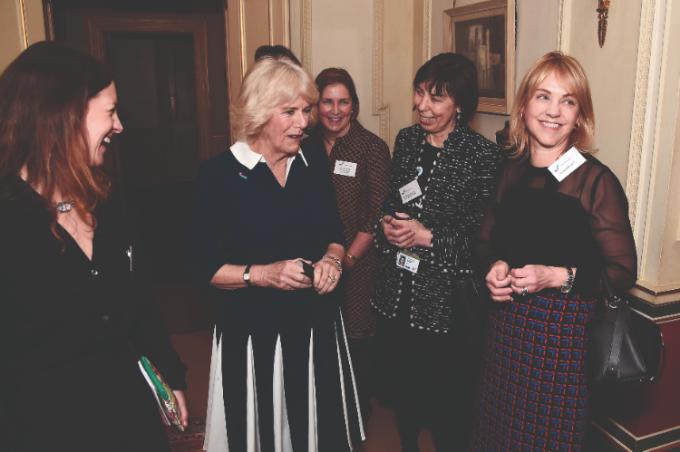
The Duchess of Cornwall meets (left to right) CEO of SafeLives Suzanne Jacob, Domestic Abuse Commissioner Nicole Jacobs, Founder of SafeLives Baroness Barran and Elizabeth Jack during a reception for SafeLives' 15th anniversary at Clarence Firm in London [Credit: Alamy]
Admitting she has a "bias" for data driven work, Barran also says she was "struck incredibly strongly" by the lack of data available on domestic abuse when she started working in the field – something that is "true across too much of the voluntary sector".
"There are no common metrics. If you and I were both going to open up up a pub, nosotros'd know what sort of margin we would take to have on the beer, how many customers eating how many meals we demand to get in pay. There just aren't the equivalent metrics for very much of the voluntary sector, so everybody's learning for the beginning time, which I'm not sure is helpful," she says.
In government she is looking to change that – particularly for areas where government is a major donor.
The section has helped fund What Works Centres, which operate more than nine dissimilar policy areas responsible for £250bn worth of government spend, to assess what policies evangelize what outcomes, as well as the Justice Data Lab. Although information technology's taken "a footling bit of time", she admits, government funding is also all now part of 360Giving, an initiative where clemency funders and benefactors input their data to see who is giving money to who, for what.
Barran is very keen on working in partnership with the third sector and other funders to deliver this cultural shift when information technology comes to impact measurement. "I don't remember government should be dictating what the metrics are," she says.
Although metrics could be every bit simple as establishing the unit toll of different types of interventions, "we have to always be terribly sensitive to avoiding creating perverse incentives – for example, setting up a metric which skews the way people work, where they avoid the most challenging cases, because they're worried near not getting paid if they don't run across that target," she says.
When information technology comes to funding, the impacts of Covid were felt unduly across unlike parts of the not-for-profit sector. While organisations were eligible for economy-wide authorities back up, Barran admits that fifty-fifty the specific £750m package for voluntary, community and social enterprises the regime appear concluding April could never have been enough to cushion the blow for everyone.
"Our objectives were: to support those charities which were providing services which in turn protected chapters in the NHS; and supporting charities that saw a detail surge in demand for their services – things like support for people experiencing mental health challenges," she says. "We never aimed to relieve the sector. That wouldn't accept been possible. But, really, comparison the percentage of redundancies and charities who sadly had to close to many parts of the for-profit economy, charities have survived incredibly well… better, perchance, than many forecast."
Having seen the work of the sector up close again in the last 15 months, Barran says it is the generosity of volunteers which has stuck with her the most.
"Whether it'southward quietly just doing shopping for a neighbour or walking their dog while they were shielding, all of those twenty-four hours-to-day kindnesses, through to coming out of retirement to be part of the vaccine effort, it's across the spectrum. That's the overwhelming matter."
While professionally she says she'southward never worked as difficult every bit in the early weeks of the pandemic, from a personal perspective Barran says she was in the "ultra-fortunate category," spending her lockdown in Bathroom with her husband and iv grown up children, who all returned domicile. "That was a treat for u.s. as parents."
If loneliness is going to exist successful, you've got to imagine you can get your female parent through the door of whatever it is that you're offering
Between them, the family unit completed all the lockdown stereotypes, she says, from making sourdough to growing vegetables and learning bridge – and they've all taken up wild pond too. It is the latter point to which we return when discussing the other function of her brief: loneliness, which she kickoff took on under Theresa May.
While albeit "you shouldn't shape government policy effectually your mum, obviously," Barran says the experiences of her mother, a Jewish refugee from Hungary who came to London lonely in World State of war II, have e'er stayed with her and influenced her approach to loneliness. "She worked in the War Office in the day and did a caste at the LSE at night, and her first Christmas in London she didn't know anybody, so she spent Christmas in the LSE library. All of u.s. tin simply imagine that'southward a pretty grim prospect," she says.
Barran follows two other pieces of advice in the brief, shared by friends and one-time colleagues.
First, from a Church of England vicar: local communities have the solutions inside them to their problems. And so if loneliness is a problem in a certain patch, ask the customs what they demand.
2d, nosotros're back to mothers, although not hers: "Somebody said to me, if loneliness is going to be successful, you've got to imagine you tin can go your mother through the door of whatever it is that you're offering.
"For almost of u.s.a., if someone said, 'Are you okay, because there is this loneliness guild in town,' I would go, 'I'1000 fine, I'thou really, actually fine'. If someone said to me, 'in that location's a wild swimming gild you could become and swim with,' I'd exist downwards similar a shot. It is about connecting people with things they enjoy. Rather than saying, 'you're lonely, we experience sorry for you lot, here's something to help', saying, 'OK, we understand you're lonely, tell us what you enjoy. We'll observe something you lot enjoy and support that'. And through that, you will make connections which will address your loneliness. I phone call it a kind of Trojan horse strategy."
Looking forwards, Barran's side by side challenge will be navigating two of import bits of legislation through the Lords – the Dormant Assets Bill, which information technology is hoped will release £900m for charities and adept causes, and the Charities Bill, which will bring into police a number of Constabulary Commission recommendations fabricated by Lord Hodgson. "He describes it as scraping barnacles off the lesser of a boat," Barran says. "None of the private measures in the bill are earth shattering, but the combination of all of them ways that there'll exist a lot less friction for charities to operate."
Her cursory will also play into the conversations near levelling up – although exactly how is nonetheless to be decided. Over again, it will have different meanings and levels of involvement for unlike parts of the sector. "We were elected – not speaking personally, obviously, merely as a government – with levelling upwardly existence a massive part of that, and nosotros are absolutely committed in everything nosotros do to brand sure that that runs through every piece of policy," she says.
For a sector increasingly worried about hostility from the government, it seems they have a friend – if a sometimes disquisitional one – in Barran at least.
PoliticsHome Newsletters
Get the inside track on what MPs and Peers are talking about. Sign up to The Business firm'due south morning electronic mail for the latest insight and reaction from Parliamentarians, policy-makers and organisations.
Source: https://www.politicshome.com/thehouse/article/baroness-barran-interview
0 Response to "Baroness Liza Abusing Her Staff Again"
Postar um comentário